
True Intentions Hidden Behind a Veil of Secrecy

Two things are essential when making plans aimed at establishing a world federation. First, outsiders must not be informed about the discussions that ecumenical partners hold to develop a confidential program of action. Second, public statements must be worded so skillfully that they garner maximum support from the majority of the population.
Why are strict secrecy precautions about the content of internal discussions important? The reason is obvious. The internationalists know that their measures would provoke immense resistance if their intentions were widely known. John Foster Dulles, a passionate advocate of ecumenism and a world federation, learned this the hard way. His substantial support for the Nazi regime, even when the United States was at war with the Axis powers, sparked a press campaign against him in America. This damaged his reputation as a “man of the church” and a “politician.”
Nevertheless, it was important to make appealing arguments to persuade the numerous members of established churches and the general public to take the political initiative to unite the nations after World War II, including those that had been enemies during the war. The preservation of world peace was always cited as the sole reason for establishing a world federation. The true reason for this was never explicitly addressed in public. To learn more, one must research the correspondence of the leading ecumenists and internationalists of that time, which is preserved in archives. That is exactly what I spent several years doing in the libraries of various renowned universities.
In the following, I reproduce an excerpt from my book World Federation:
Representative Church leaders and Christian laymen from twelve countries participated at the ‘International Round Table of Christian Leaders’, at Princeton, NJ, on 8-11 July 1943, including the General Secretary of the British Council of Churches and ecclesiastical executives from Canada, New Zealand, and Australia. They were joined by the former president of Doshisha University in Kyoto, the president of Ginling College, China, as well as government representatives from the United States, Switzerland, and the Netherlands. Their primary purpose was to formulate an agenda for peace by insisting on the need to institute a world government.
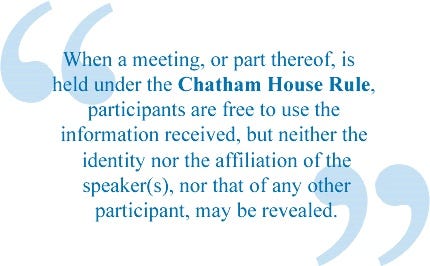
In order to assure an atmosphere of openness and free discussion journalists and visitors were not allowed to participate at the conference. Since the group of delegates was relatively small, it was possible to meet in general session as a body, and discussion and dialogue took the place of formal presentations during the four-day conference. The Round Table selected a Guiding Committee of six men from five nations to identify the points of discussion which had met substantial agreement in previous study papers, and to draft and submit for consideration of the Round Table statements relating to these issues. The results of the proceedings were summarised and released for publication to the Associated Press, United Press and International News Service, and the three principal press associations. In addition, dispatches were sent to the Standard News Association, New York (servicing the New York metropolitan area), Religious News Service, Canadian Press, Australian Associated Press, New York Times, New York Herald Tribune and the Christian Science Monitor, Boston.
The publication of “Musings of the Court Jester” relies on donations. If you have found spiritual orientation in this text, we would appreciate a one-time or recurring donation to support our ministry. May the Lord reward you!